Never Surrender (2026): A Siege That Tests Family Bonds
A guilt-ridden veteran and the grandchildren he barely knows must survive a deadly gang siege in Never Surrender.
November 15, 2026
The Ending, Explained
If you have just finished the film and you are hunting for a Never Surrender ending explained piece that takes the final act seriously, this breakdown is for you. Sidharta Tata's 2026 thriller spends most of its runtime tightening a single knot: a guilt-ridden veteran living far from civilization, and the two grandchildren he barely knows, trapped together when a deadly gang arrives at his door. The last stretch pays that tension off, and it does so in a way that is more interested in emotional consequence than in shock reveals. So let us walk through the closing stretch carefully, without giving away how the first act sets the trap.
What Happens
By the time the final act arrives, the remote house is no longer a refuge — it is a fortress under siege, and the family inside it has run out of easy options. The veteran, played by Lukman Sardi, has spent the earlier chapters holding his grandchildren at arm's length, and the siege forces him to do the opposite: to trust them, to communicate with them, and in some cases to fight alongside them. His granddaughter, played by Callista Arum, and his grandson, played by Sulthan Hamonangan, each find a role in the defense that the old man could not have scripted himself.
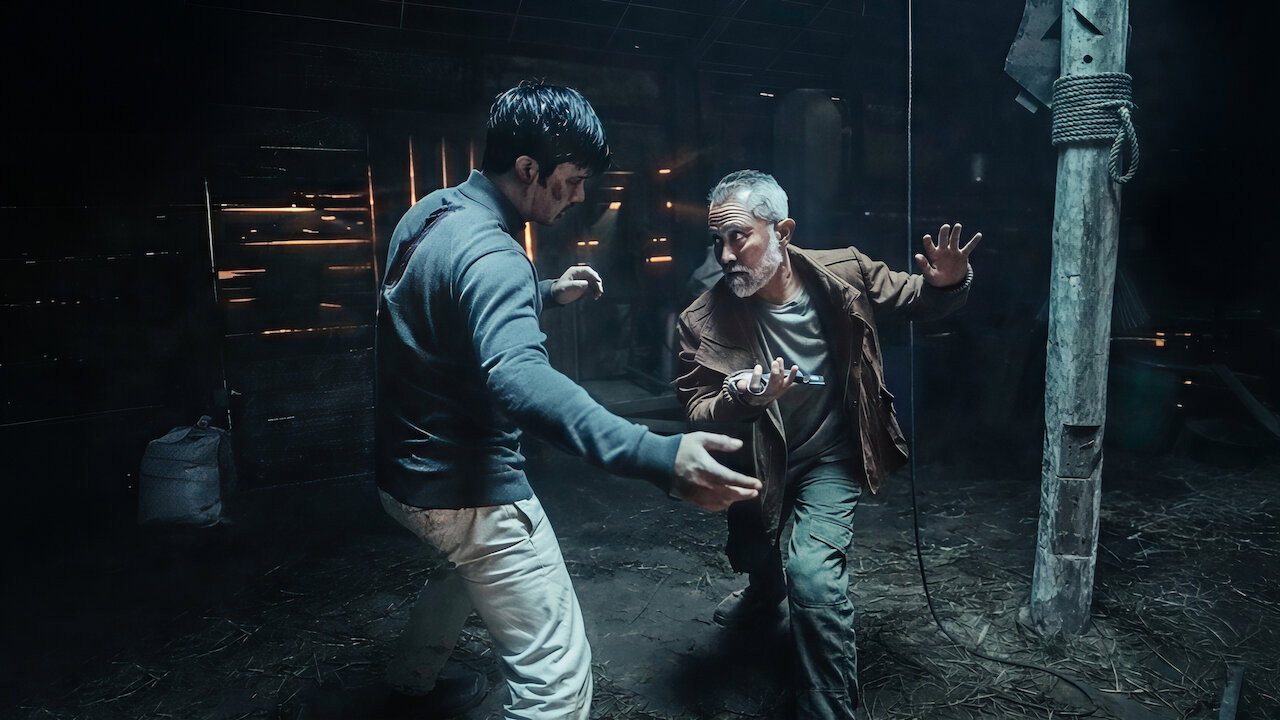
The film's title becomes a literal instruction in this stretch. The gang, led by figures played by Donny Alamsyah and Derby Romero, keeps pressing, and the household keeps refusing to break. What follows is a series of improvised, close-quarters confrontations in which the veteran's training resurfaces alongside his guilt — the sense that he failed people before and cannot fail these two. If you want to know precisely what happens at the end of Never Surrender, the honest answer is that the siege resolves in favor of the family, but not without a cost that lands on the old man rather than on the children.
The confrontation with the syndicate's leadership is where the film places its heaviest beat. The veteran and the gang's enforcers meet directly, and the fight is staged as a one-man stand that the rest of the household supports rather than watches. It is the point where his estrangement from the kids is finally closed, and it happens through action rather than dialogue. Longtime fans of survival thrillers might compare the mood to 6 Bullets, another story about a veteran who protects people he barely owes anything to, though this film keeps its focus tighter on family.
The Meaning Behind the Ending
The Never Surrender ending meaning is not about who wins the gunfight. It is about what the grandfather is willing to give up to become part of a family again. His guilt has kept him isolated; the siege forces him to re-enter the world through the two people he treated as strangers. The final act makes the point that survival, in this story, is a shared act, not a solo one, even though the veteran is the one doing most of the fighting.
That is why the film's tagline-sized phrase matters. The title is not just about refusing to die; it is about refusing to surrender the people you love to your own regret. The children, meanwhile, get their own arc: they stop being liabilities in the defense and become participants. The estrangement that defined the opening is gone by the final reel, replaced by something sturdier. Read that way, Never Surrender explained in a single sentence is a redemption story disguised as a siege thriller, and the ending is the moment the disguise drops.
It also matters that the ending withholds easy triumph. The family survives, but the cost is placed on the old soldier, which keeps the film honest about what a one-person stand actually takes out of a person. You can see the same instinct in Hellhound, where the pursuit story is really about the weight the protagonist carries afterward.
Themes You Might Have Missed
- Communication as armor. Sign language runs through the film as a quiet motif, a reminder that this family's failure was never about danger but about not hearing each other.
- Guilt as a weapon. The veteran's past is not backstory filler; it is what makes him both dangerous and brittle when the gang arrives.
- The elderly protagonist as the last line of defense. The film deliberately gives the heaviest burden to the oldest person in the house, and the finale argues that experience is a form of strength.
- Militarization of a home. Ordinary objects, ordinary rooms, turned into a perimeter — the film uses domestic space to make the siege feel personal.
None of these themes are announced with dialogue. They surface through repetition and through the way the final act is staged, which is why a second viewing rewards attention.
Our Rating for Never Surrender
We would put Never Surrender 2026 finale in the solid-thriller tier: a 140-minute action crime picture with a clear emotional spine and a director, Sidharta Tata, who trusts the cast to carry the quieter moments. The current audience score of roughly 7.1 out of 10 fits that read. It is not a twist-driven film, and viewers who want a puzzle-box ending will find the resolution straightforward. What it offers instead is a family drama with a very loud third act. For a free-streaming night in, that is a fair trade, and the finale earns its runtime.
If you liked the "protect the people under your roof" angle here, Trap House is a reasonable next pick, though it trades the family dynamic for a tighter single-location pressure cooker.
Never Surrender Highlights
- Lukman Sardi anchors the film as a veteran whose guilt is more dangerous to him than the gang outside.
- Callista Arum and Sulthan Hamonangan turn the estranged-grandchildren setup into a real arc instead of a plot device.
- Donny Alamsyah and Derby Romero give the syndicate a credible, unnerving presence.
- The siege staging in the final act is the film's clearest strength: close, physical, and personal.
- At 140 minutes, the film earns its length by keeping the family at the center of every action beat.
The final word: the ending is not a riddle to solve. It is a character decision, and once you see it that way, the whole film clicks into place.